Sixteen papers, five technical routes, one universal equation
Abstract: When humanoid robots are deployed in human environments such as homes, hospitals, and offices, they face a common control challenge: they must both apply precise contact forces (wiping a whiteboard, opening a cabinet door) and yield compliantly upon collision (avoiding damage to objects or injury to humans). The prerequisite for all of this is that the robot must simultaneously sense and control "force" and "position"—that is, hybrid force-position control. However, force sensors are costly, fragile, and difficult to cover multiple contact points, making "force estimation without force sensors" a core piece of infrastructure in this field. This article surveys the technological evolution of hybrid force-position control from divide-and-conquer toward unification from 2024 to 2026, focusing on three core threads: (1) how the impedance equation
1. Why Humanoid Robots Need Hybrid Force-Position Control
The essential characteristics that distinguish humanoid robots from fixed-base manipulators are: floating base, high center of mass, multiple contacts, and strong underactuation. These characteristics cause purely position-based control strategies to fail in a large number of real-world scenarios.
Consider three typical tasks. Wiping a whiteboard: the end-effector must maintain a stable normal contact force — too light and the writing cannot be erased, too heavy and the board surface or robot joints may be damaged. Opening a push-to-open cabinet door: the travel of the cabinet door's trigger mechanism is only about 3 mm, nearly imperceptible visually; the robot must sense the buildup of reaction force and continue applying force until the mechanism triggers. Physical human-robot interaction: when an operator pushes the robot's arm for teaching, the robot must yield with predictable compliance rather than resisting with maximum torque.
The common requirement of these tasks is: controlling position and force simultaneously.
Classical robotics provided the theoretical framework as early as forty years ago. Raibert and Craig (1981) proposed hybrid position/force control [Raibert1981], decomposing the task space into a position-controlled subspace and a force-controlled subspace. Hogan (1984) proposed impedance control [Hogan1984], which does not directly control force or position, but rather regulates the dynamic relationship between the two:
This formula laid the theoretical cornerstone for hybrid force-position control over the following four decades. However, classical methods face three practical bottlenecks: (1) they require an accurate robot dynamics model, and model identification for humanoid robots is extremely difficult; (2) they rely on force/torque sensors, which are costly, have low signal-to-noise ratios, are easily damaged under impact, and are difficult to deploy at all possible contact points; (3) in multi-contact scenarios, force distribution has a redundant null space, and heuristic single-effector admittance schemes [Kajita2010, Murooka2022] cannot coordinate whole-body force allocation.
The turning point came in 2024. Portela et al. [Portela2024] demonstrated for the first time at CoRL 2024 that reinforcement learning (RL) policies can learn to apply precise end-effector forces (error 5–10 N) on a quadrupedal manipulator without using any force sensors, relying solely on proprioceptive signals such as joint encoders and IMU. This work opened a wave of research on "learning-based hybrid force-position control." In the subsequent 18 months, the field underwent rapid evolution from "divide-and-conquer" to "unified" approaches, and in 2025–2026 it saw a concentrated explosion of work on humanoid robots.
2. One Equation to Unify Everything: From Mode Switching to Continuous Compliance
Between 2024 and 2025, the control interface for hybrid force-position control underwent three key abstraction upgrades. Understanding these three leaps is to understand the core methodological progress in this field.
2.1 Portela2024 — Breaking the Ice: The First Learned Whole-Body Force Control
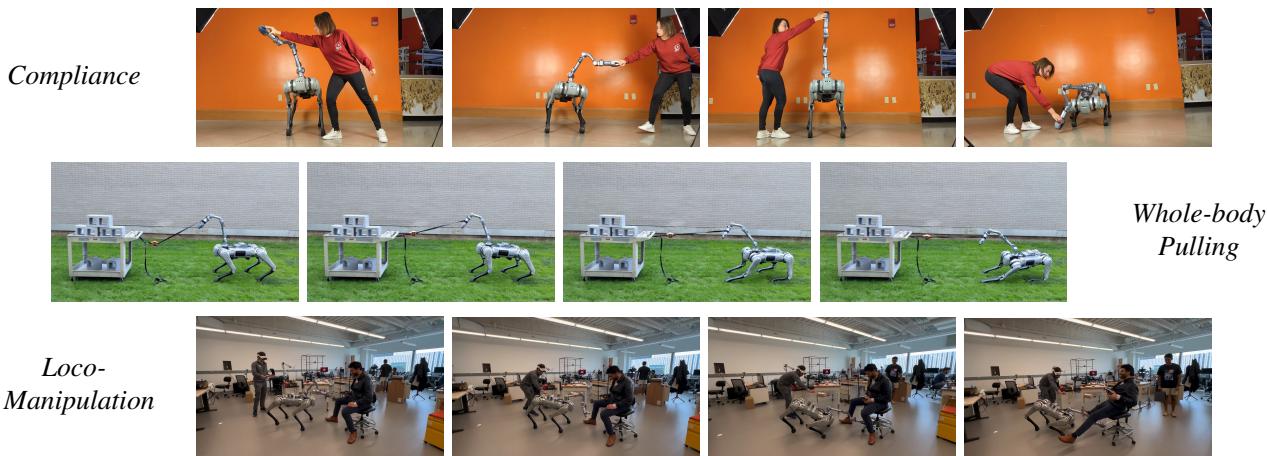
Figure: Portela et al.'s whole-body force control policy. Top: compliant interaction; Middle: whole-body force exertion; Bottom: impedance-controlled teleoperation. [Portela2024]
Portela et al. [Portela2024] trained a PPO policy on a Unitree B1 quadruped + Z1 arm platform. The policy receives four types of commands: end-effector position
The key innovation in force training is that real contact geometry is not modeled in simulation; instead, a spring-damper potential field
The experimental results are landmark: force tracking error of 5–10 N, whole-body coordination expanding workspace volume by 59%, and a maximum pulling force of 90 N (far exceeding the arm's rated payload of 36 N). By setting the end-effector force command to zero, the policy exhibits a gravity-compensated compliant mode — an operator can drag the robot arm as if swinging a physical spring.
But the method's limitation is equally obvious: the user must explicitly switch between position mode and force mode. This means the policy cannot simultaneously track the direction of motion and regulate the normal force while wiping a whiteboard — which is precisely the classic requirement of hybrid force-position control.
2.2 Zhi2025 — Unification: One Equation, Four Modes
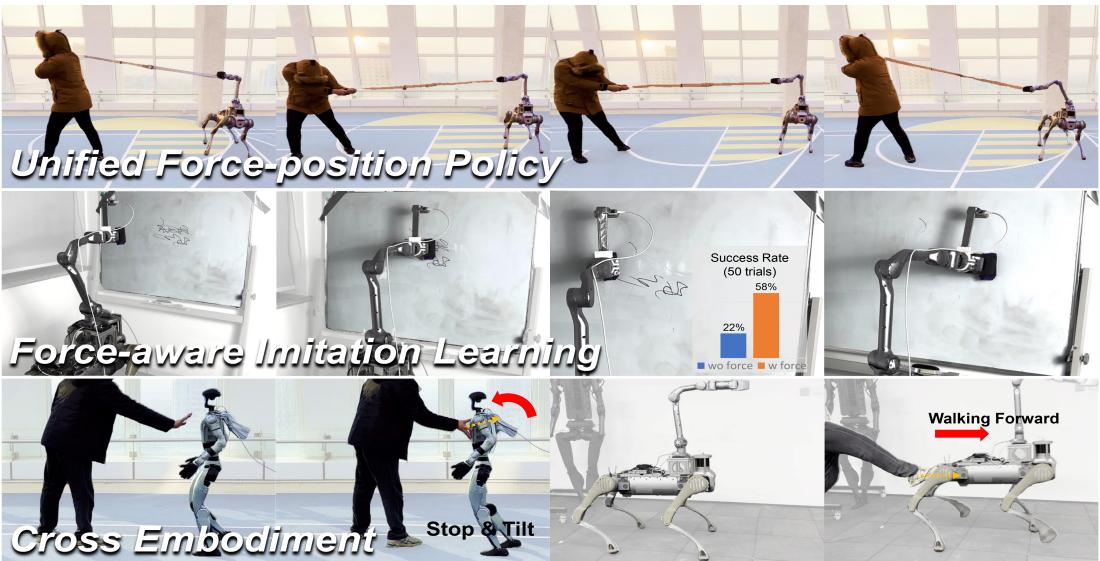
Figure: Zhi et al.'s unified force-position policy. Top: force-position control behaviors (position tracking, force exertion, compliant interaction); Middle: force-aware imitation learning; Bottom: validation on quadruped and humanoid robots. [Zhi2025]
The work by Zhi et al. [Zhi2025] at CoRL 2025 fundamentally resolves the mode-switching problem. Their core insight is that all control modes — position control, force control, impedance control, hybrid force-position control — can be derived from a single impedance control framework.
Given a position command
This concise formula unifies four fundamental behaviors:
- Position control:
- Force control:
- Impedance control: subject only to external force
- Hybrid force-position control: tracking position along the tangential direction of motion while applying force command
The formula is likewise generalized to base velocity control:
Zhi et al.'s policy was validated on both a Unitree B2-Z1 quadruped arm and a Unitree G1 humanoid robot — the first cross-embodiment deployment in this direction. More critically, they demonstrated the value of force information for imitation learning: using the policy's built-in force estimator to collect force-aware demonstration data and training a Diffusion Policy improved success rates by an average of 39.5% across four tasks — wiping a whiteboard, opening/closing cabinet doors, and occluded drawer manipulation (0.22 → 0.58, 0.36 → 0.70, 0.30 → 0.72, 0.30 → 0.76). In the visually occluded drawer task, the vision-only baseline achieved a success rate of only 0.30, which improved to 0.76 with force estimation — fully demonstrating the irreplaceability of force information in visually degraded scenarios.
2.3 FACET2025 — Continuity: Compliance Becomes a "Knob"
FACET [Xu2025] pushes the abstraction level one step further: the control interface is no longer force/position commands, but the impedance parameters themselves —
The key technical contribution is the mixed-timescale reference target integration:
By mixing open-loop (setpoint only), closed-loop (full impedance), and intermediate integration scales, FACET finds a balance between compliance and tracking stability. Experimental validation spans three embodiments (Unitree Go2 quadruped, G1 humanoid, B1+Z1 arm), achieving an 80% reduction in collision impulse in compliant mode and withstanding external impulses of 200 Ns without losing stability.
2.4 The Logic of the Three Leaps
Looking back at 18 months of evolution: the control interface went from "two buttons" → "one equation" → "one knob." Each abstraction reduced the dimensionality of complexity while enhancing expressive capability. The core driving force of this evolution is the generality of the impedance control formula — the same
3. Without force sensors, how do you "sense" force?
Hybrid force-position control presupposes access to force information. Since we are not relying on force sensors, the quality of force estimation becomes the precision ceiling for the entire system. Existing methods can be divided into five technical routes.
3.1 Route 1: MLP state estimator (Portela → Zhi → FACET)
This is the mainstream approach for learning-based force control. In the RL training loop, the policy includes an MLP state estimator that predicts external forces
The advantage of this approach is its simplicity: it integrates seamlessly with RL training and requires no additional network design or physical knowledge. The estimator in Zhi et al. [Zhi2025] also predicts end-effector position and base velocity simultaneously, achieving "end-effector position estimation in the world frame," which enables the policy to naturally trigger whole-body coordination behavior at workspace boundaries.
However, pure MLP estimation has a precision ceiling. Both Portela and Zhi report estimation errors of 5–10 N, and the sim-to-real gap is significant—force estimation on real hardware shows particularly prominent bias along the Y-axis. This is partly because MLPs lack physical consistency constraints: what they learn may be a statistical correlation of "joint angle patterns → force" rather than a causal dynamics relationship, so their out-of-distribution generalization is limited.
3.2 Route 2: Physics-informed constraints (QuietWalk)
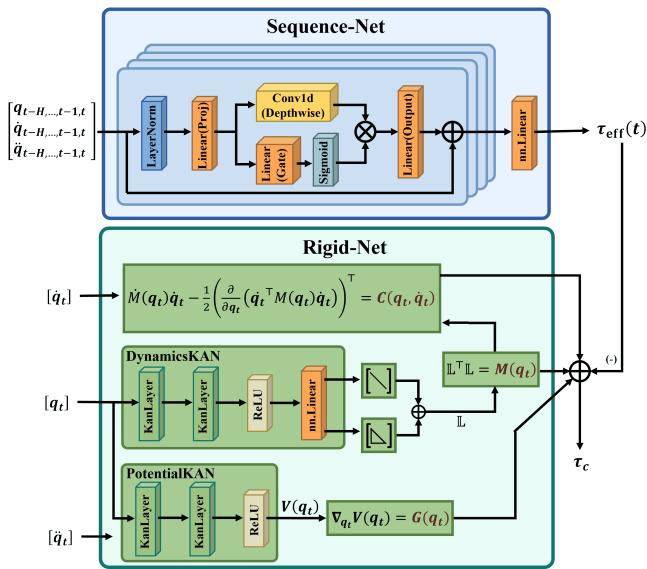
Figure: QuietWalk's PINN architecture. DynamicsKAN learns
QuietWalk [Hu2026] represents the opposite pole of force estimation: using physics-informed neural networks (PINNs) to embed inverse dynamics consistency into the loss function, fundamentally changing the reliability of estimation.
The core design of its GRF predictor is as follows. The input is proprioceptive history
The training loss jointly optimizes four terms:
where
These results establish an important principle: data-driven methods can capture force patterns, but only physical constraints can guarantee force accuracy. Both are indispensable.
3.3 Route 3: Analytical model + complementary filtering (SEIKO)
SEIKO [Rouxel2024] represents the model-driven route. Its core idea is that real joint position control is not perfectly rigid—structural bending and the internal impedance of PD control produce modelable compliance. By explicitly modeling each joint as a spring
The advantages of this method are extremely high computational efficiency, clear physical semantics, and good robustness (insensitive to model errors, since the QP only depends on the approximate direction of derivatives). The limitation is that the quasi-static assumption restricts its applicability to dynamic motions.
3.4 Route 4: Dynamics-structured networks (ABD-NET)

Figure: ABD-NET architecture overview on a quadruped robot. (a) Per-link observation encoding; (b) dynamics message passing (leaf-to-root, mimicking ABA inertia aggregation); (c) action decoding. [Shin2026]
ABD-NET [Shin2026] offers a fundamentally new idea at the network architecture level: rather than explicitly estimating forces, it makes the structure of the policy network itself reflect the computational graph of forward dynamics. Specifically, it adopts the leaf-to-root inertia propagation pattern of the Articulated Body Algorithm (ABA): each link
3.5 Route 5: CFM generative probabilistic inference (SixthSense)
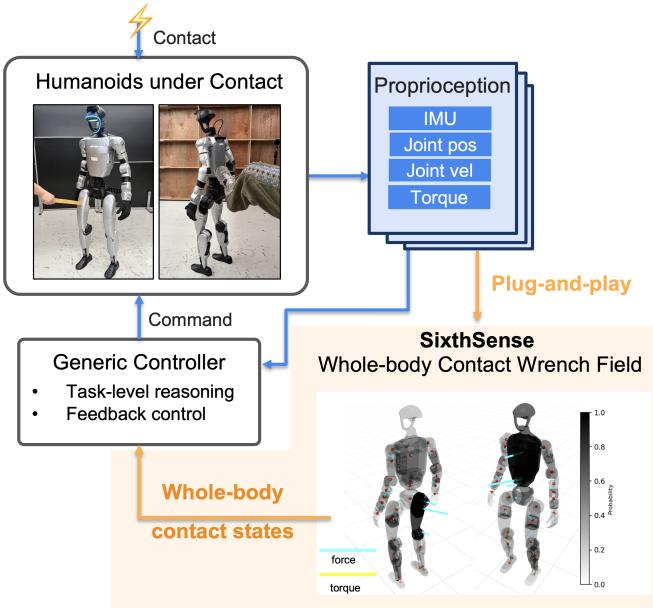
Figure: SixthSense concept overview. Inferring whole-body contact force fields through proprioception, providing a general perceptual foundation for downstream control and decision-making. [Chen2026]
The first four routes share a common limitation: they only handle foot contacts (QuietWalk/ABD-NET), known end-effector contacts (MLP estimator/SEIKO), or model forces indirectly rather than estimating them directly (ABD-NET). SixthSense by Chen et al. [Chen2026] proposes an entirely new route: modeling whole-body force estimation as a generative probabilistic inference problem, outputting probabilistic contact masks and six-dimensional force/torque for all 30 links on the robot's surface.
Core method. SixthSense discretizes the robot surface into N sub-regions (N=30 on the Unitree G1), predicting a contact mask
The key innovation is using Conditional Flow Matching (CFM) in place of deterministic regression. CFM learns a time-varying velocity field
where
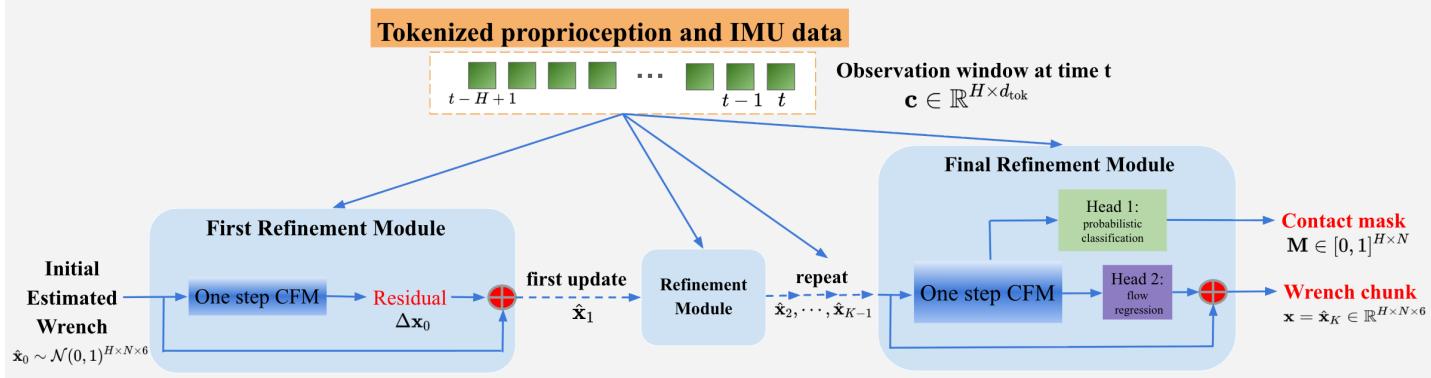
Figure: SixthSense architecture. CFM backbone + dual-head decoder (contact mask head + force field head), progressively inferring whole-body contact masks and external force fields from proprioceptive observation windows. [Chen2026]
The model uses a shared backbone + dual-head decoder design: one CFM encoder captures shared contact semantics, and two lightweight attention heads decode contact probability and force field respectively. The training loss jointly optimizes four terms:
The framework also contains a profound insight: controller robustness determines contact observability. Contact-robust policies (trained via domain randomization) produce more consistent and more informative proprioceptive responses to external disturbances—conversely, data generated by non-robust policies leads to higher false-positive rates when training force estimators. Ablation studies quantitatively verify this bidirectional coupling.
Key results. Experiments on the Unitree G1 cover three task categories: standing, walking, and whole-body motion tracking. Force estimation accuracy: magnitude error 1.7–2.1 N, direction error 17–29°, torque magnitude error 0.3–0.7 N·m (see table in Section 3.6). Contact detection: 84.2% detection rate with only 0.4% false positives during standing, and 85–98% hit rate under a ±0.1 s time tolerance.
The most impressive finding is zero-shot multi-point contact generalization. A CFM model trained only on single-point contact data achieves an 89.3% detection rate in multi-point simultaneous contact scenarios—while a deterministic MLP of equivalent capacity plummets to 17.2%. The MLP can reach 99.7% detection on single-point contacts but completely collapses under multi-point ambiguity, because its deterministic mapping cannot represent a multimodal posterior. CFM naturally maintains diverse hypotheses through flow-based sampling. Comparison with model-based methods (GMO [Haddadin2017], CPF [Manuelli2016]) is equally striking: CPF's false-positive rate grows exponentially with the number of contact points (reaching 85.8% at 5 points), while SixthSense remains at only 17.0%.
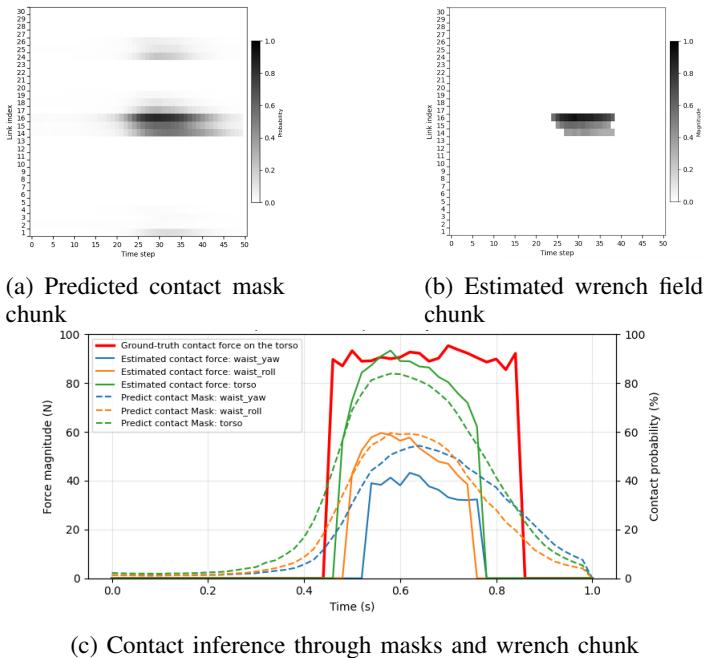
Figure: Contact force field estimation on a real Unitree G1. (a) Predicted contact mask M ∈ [0,1]^{50×30}; (b) predicted force field magnitude ‖W‖; (c) final estimated contact location and force magnitude. [Chen2026]
Positioning within the five routes. SixthSense is the only route that achieves whole-body multi-point force estimation. Its probabilistic output naturally provides uncertainty quantification, making it suitable for combination with Bayesian decision-making or risk-aware MPC. The main limitations are inference latency (~500ms vs. <1ms for MLP) and link-level spatial resolution. Extending the CFM conditioning from purely proprioceptive sensing to modalities such as vision and language, and accelerating inference to real-time levels, are the key next steps for this route.
3.6 The precision spectrum of the five routes
| Method | Force estimation accuracy | Physical consistency | Computational cost | Applicable scenarios |
|---|---|---|---|---|
| MLP state estimation | 5–10 N | No guarantee | Low (inference embedded in RL) | Coarse-grained manipulation |
| PINN + inverse dynamics |
|
Strong (dynamics residual constraint) | Medium (offline training + frozen inference) | Precision force control, safety-critical |
| Joint flexibility + QP | Depends on model accuracy | Strong (explicit physical model) | Very low (0.4 ms/QP) | Quasi-static multi-contact |
| Dynamics-structured GNN | Does not directly estimate force | Medium (soft regularization) | Medium (GNN inference) | Policy learning efficiency improvement |
| CFM generative | 1.7–2.1 N (magnitude) | Medium (implicit constraint from CFM convergence) | Relatively high (~500ms/step) | Whole-body multi-point sensing, pHRI |
No work has yet emerged that combines the strengths of these five routes — for example, using a PINN-level-accuracy force estimator to provide reward signals for an RL policy (which QuietWalk has already achieved), while using CFM's whole-body sensing to cover non-foot contacts (which SixthSense has already achieved), and having the policy network adopt an ABD-NET-style dynamics structure (the fusion of the three would produce a force-sensing + force-control framework that is both precise and comprehensive).
4. Application I — Compliant Interaction: From Rigid Tracking to Controllable Compliance
Force estimation is the infrastructure that makes compliant control possible. In 2025, this direction produced two sharply contrasting technical approaches.
4.1 SoftMimic — Learning Compliance from Examples
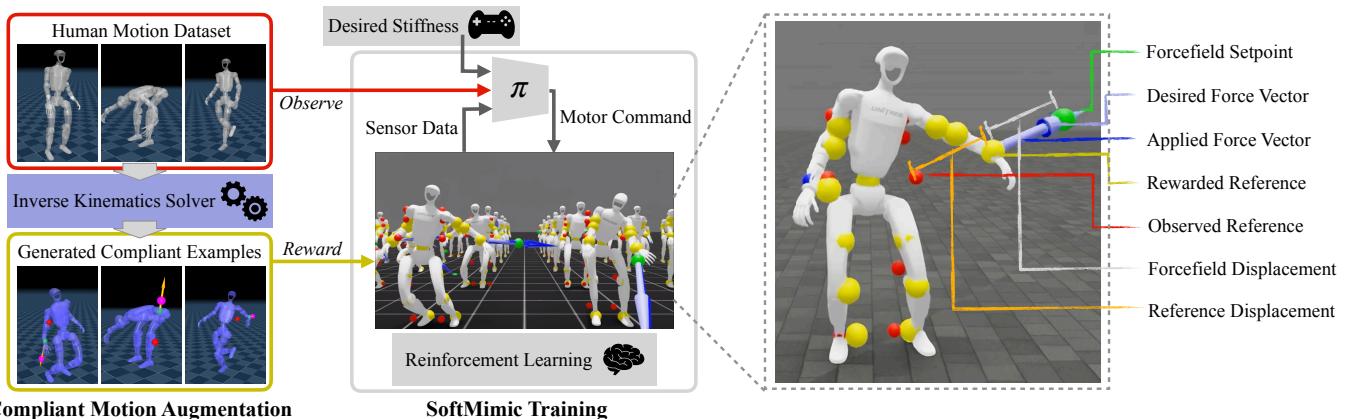
Figure: SoftMimic's compliant whole-body control framework. Left: an offline IK solver generates an augmented compliant dataset from raw reference motions and external force/stiffness parameters
SoftMimic by Margolis et al. [Margolis2025] addresses a specific problem: RL-based humanoid motion tracking policies are inherently "stiff" — any deviation from the reference motion is treated by the reward function as an error to be forcibly corrected, causing the robot to exert uncontrolled, large forces during unexpected contact.
SoftMimic's approach has two steps. First, Compliant Motion Augmentation (CMA): a differentiable IK solver is used offline to generate an augmented dataset
The key insight of this design is: the policy's compliance level is determined by the high-level objective (reward function), not by low-level PD gains. Even with fixed, moderate PD gains, the policy can modulate force output by deliberately creating position errors. SoftMimic achieved a stiffness range of 40–1000 N/m on the Unitree G1, validating controllable compliance across standing, walking, object pickup, pouring, and dancing. Using the same 20 cm box-grasping motion as reference, the policy successfully generalized to boxes of different widths while consistently maintaining a gentle squeezing force.
4.2 CHIP — Hindsight: One-Line Modification, No Augmentation Needed
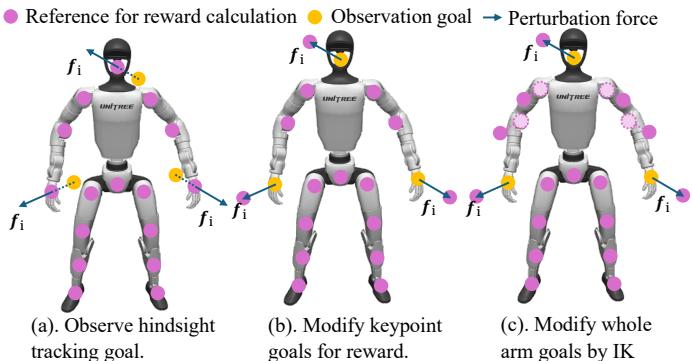
Figure: Comparison of three compliant tracking policy training schemes. (a) CHIP — modifies the sparse tracking target in the input space (hindsight perturbation), with rewards computed against the original reference; (b) GentleHumanoid — modifies keypoint targets in reward computation; (c) SoftMimic — edits the full kinematic reference trajectory to account for end-effector perturbations. [Chen2025]
CHIP [Chen2025] (NVIDIA) reduces SoftMimic's complexity dramatically in an elegant way. Its core insight comes from re-examining the training process:
- SoftMimic's approach: modify the reference motion
- CHIP's approach: modify the tracking target
Specifically, during training, random perturbation forces
The biggest advantage of this method is scalability: no offline IK solver, no need to generate augmented data for each motion clip, no need to modify the reward function. It can be integrated as a plug-and-play module into any keypoint-based motion tracking framework. CHIP maintains compliant control quality comparable to SoftMimic on tasks such as wiping, door opening, box carrying, cart pushing, and writing, while also supporting multi-robot cooperative grasping (global 3-point tracking + compliant grasp planning).
4.3 Insights from the Two Paradigms
SoftMimic and CHIP represent two philosophies of data-driven compliant control: meticulous offline preparation vs intelligent online perturbation. The former trades computation for precision; the latter trades design for efficiency. From a practical standpoint, CHIP's scalability advantage makes it more likely to become the default approach for training compliant humanoid policies on future large-scale motion datasets.
5. Application II — Quiet Walking: Force-Sensing-Driven Low-Noise Locomotion
Foot-ground impact is the primary noise source when humanoid and quadruped robots are deployed indoors. QuietWalk [Hu2026] and MUTE [Cao2025] address this problem at different levels of fidelity, and the contrast between them clearly illustrates the upgrade path from "kinematic proxies to direct dynamics modeling."
5.1 MUTE — A Kinematic Proxy Approach
MUTE [Cao2025] introduces a "quiet factor"
However, penalizing foot velocity is an indirect proxy: it assumes that low contact velocity necessarily implies low impact force. This assumption holds in some cases but is not precise — a fast light touch and a slow heavy stomp can produce entirely different forces and noise, yet a velocity proxy cannot distinguish between them.
5.2 QuietWalk — A Physics-Informed Direct Approach
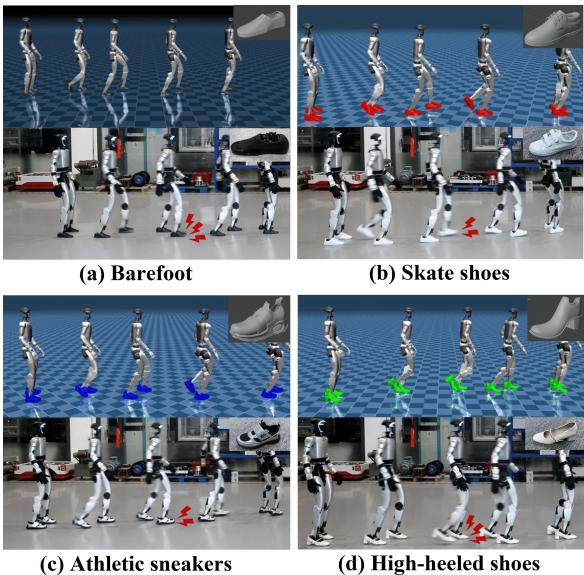
Figure: QuietWalk's cross-footwear validation in simulation and on the real Unitree G1 humanoid robot: barefoot, skate shoes, sneakers, and high heels. [Hu2026]
QuietWalk [Hu2026] replaces the velocity proxy with its PINN GRF predictor. Specifically, the frozen GRF predictor serves as a "physics reward critic" inside the RL training loop, directly penalizing the predicted impact force:
Walking at 1.2 m/s on the Unitree G1 humanoid robot (barefoot, averaged over four surfaces), QuietWalk achieves a mean noise level (MNL) reduction of 7.17 dB (89.47 → 82.30 dBA) and a peak noise level (PNL) reduction of 4.98 dB. The noise reduction is surface-dependent — greater improvement on concrete and carpet, smaller on wood flooring and yoga mats (the latter being inherently more damped).
A more important finding comes from the cross-footwear experiments. QuietWalk systematically tested four conditions — barefoot, skate shoes, sneakers, and high heels — across four surfaces. The results show that highly cushioned/highly damped footwear (skate shoes, sneakers) tends to reduce noise, while high heels significantly increase noise due to high contact stiffness and short contact duration — the noise difference between the worst combination (high heels × wood flooring) and the best combination (sneakers × yoga mat) approaches 20 dB. This order-of-magnitude difference indicates that footwear-surface contact dynamics are a key variable in quiet walking, and current force-control policies still face challenges under high-stiffness/low-damping contact conditions.
5.3 From Proxy to Direct Modeling
The evolution from MUTE (foot-velocity penalty) to QuietWalk (direct GRF penalty) represents a paradigm shift with broad significance in the field of hybrid force-position control: kinematic proxies can only indirectly approximate the effect of force, whereas physics-informed force estimation can directly optimize force itself. QuietWalk's ablation study strongly supports this view — once the inverse dynamics constraint is removed, the GRF prediction's
6. Frontiers — Force Adaptation and Extreme Conditions
6.1 Whole-Body Control under Extreme Force Disturbances
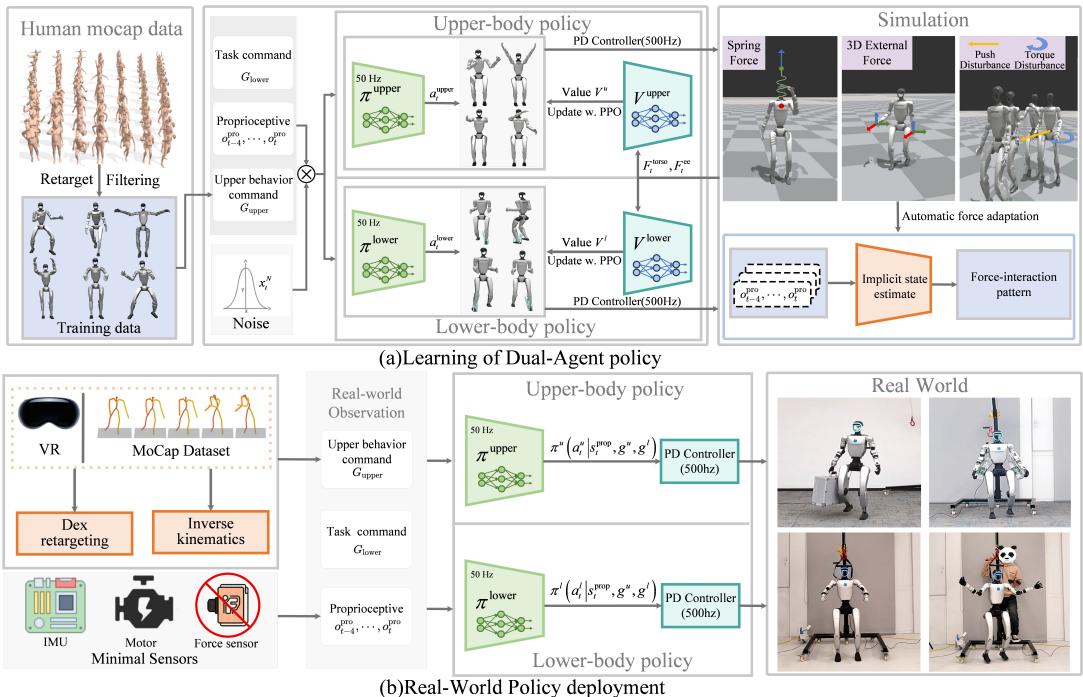
Figure: HAFO dual-agent force-adaptive framework. (a) Policy training — dual-agent RL with upper-lower body decoupling, introducing multiple explicit dynamics disturbances; (b) Policy deployment — teleoperation-based humanoid robot control system. [Dong2025]
Most current learning-based force control methods are trained and evaluated under mild force disturbances (<70 N, quasi-static). HAFO [Dong2025] pushes the boundary of force adaptation to extreme conditions.
HAFO adopts a dual-agent architecture: the lower-level policy handles robust locomotion (velocity-command driven), while the upper-level policy handles precise upper-limb manipulation (reference trajectory tracking). The two share the state space to maintain coordination. The key technical innovation is the use of a virtual spring-damper system to explicitly model external pulling forces:
By gradually adjusting the desired pelvis position
Experimental results demonstrate the framework's robustness: (1) maintaining upper-limb motion tracking error of 0.41 rad under 30 N external force per hand, versus 0.74 rad for the baseline; (2) rapid balance recovery under a lateral 250 N push (0.2 s impulse); (3) the first demonstration of stable humanoid robot control under rope suspension — the policy autonomously switches between ground locomotion and suspended states without an explicit state machine. This capability has pioneering significance for humanoid robot applications in hazardous environments such as high-altitude operations.
FALCON [Zhang2025] advances a similar goal in the mobile manipulation direction: a single policy maintains walking stability while applying 60 N end-effector force. Force feedback is critical for balance maintenance — ablation studies show that without the force estimation module, the robot tips over under large contact forces.
6.2 The Complete Spectrum from Model-Based to Learning-Based Methods
Arranging all methods in this survey along the "model-driven vs. data-driven" dimension reveals a complete spectrum from purely model-based to purely learning-based:
- Pure model end: SEIKO (QP, 500 Hz, quasi-static) → adaptive force-control MPC (L1 + NMPC, 200 Hz) → whole-body inverse dynamics MPC (torque-level optimization, 80 Hz, Fatrop solver [Molnar2025])
- Hybrid end: Opt2Skill (trajectory optimization generates references + IL distills into a real-time policy [Liu2024])
- Pure learning end: Portela (binary switching) → Zhi (unified equation) → FACET (impedance reference) → SoftMimic (IK-augmented learning) → CHIP (online disturbance, plug-and-play)
A key observation is that no successful "model prediction + learned residual" hybrid scheme currently exists for force control. That is, no one has combined model predictive control (providing constraint satisfaction and long-horizon planning) with a learned residual policy (handling model uncertainty and unstructured environments) for hybrid force-position control. Given the respective limitations of the two endpoints — model-based methods constrained by quasi-static assumptions and known contact sequences, learning-based methods constrained by force estimation accuracy of ~5–10 N — this gap represents a high-value research opportunity.
7. Challenges and Outlook
Synthesizing the collective findings of the 16 papers above, the following challenges constitute the research frontier for the next 2–3 years.
Identified Research Gaps
-
Multi-point force coordination: SixthSense [Chen2026] has advanced multi-point force estimation to the zero-shot generalization stage, but whole-body coordinated allocation optimization of multi-point forces remains an open problem. Scenarios requiring simultaneous body support and arm-based door pushing—multi-point force estimation + whole-body force allocation optimization—still lack a complete solution. Both Zhi et al. [Zhi2025] and SEIKO [Rouxel2024] list this as an explicit direction for future work.
-
Full 3D force/torque modeling: QuietWalk models only the normal GRF component. Most RL methods track only Cartesian 3D forces. SixthSense's six-dimensional force field is an important breakthrough in this direction, but its torque accuracy (17–35° orientation error) still leaves considerable room for improvement. Tangential friction forces and torques—critical for tasks such as door opening and screw tightening—await deeper integration into learning-based force control frameworks.
-
Unified evaluation benchmarks: Each paper defines its own tasks and its own metrics (wiping success rate, force error in N, noise reduction in dBA). The field urgently needs a standardized force-position control benchmark—analogous to the role ImageNet played for computer vision.
-
Safety guarantees: The compliance modulation in FACET/SoftMimic/CHIP is empirical. Robots may still exert dangerous forces when policy estimation fails. Formal force bounds and passivity guarantees—especially in physical human-robot interaction scenarios—are prerequisites for deployment.
-
High-frequency force control: The 50 Hz control loop filters out impact transients above 100 Hz. Applications requiring high-frequency force modulation, such as precision assembly and polishing, are currently infeasible.
-
Force-aware long-horizon planning: All current methods are reactive—estimate force → compensate immediately. No work integrates force estimation into long-horizon model predictive control. The inverse-dynamics MPC of [Molnar2025] provides the closest foundation for such fusion, but its end-effector force constraints are currently open-loop commands rather than estimated feedback.
The Most Exciting Fusion Direction
We believe the most promising direction for the next 2–3 years is the deep integration of physics-informed force estimation with learning-based whole-body control. Specifically:
- Force estimation layer: adopt QuietWalk-style PINNs, ABD-NET-style dynamics-structured networks, or SixthSense-style CFM generative inference to provide
- Control layer: adopt the unified impedance framework of Zhi/FACET/CHIP to convert force estimates into continuous compliance modulation and whole-body coordination
- Planning layer: integrate the above closed-loop force estimation into an inverse-dynamics MPC framework to achieve force-aware long-horizon predictive control
The integration of these three layers will enable humanoid robots to safely, precisely, and autonomously complete contact-intensive tasks in unstructured human environments—from wiping tables to assisted carrying—thereby truly entering human workspaces and living spaces.
References
- [Raibert1981] Raibert, M.H. & Craig, J.J. (1981). Hybrid Position/Force Control of Manipulators. ASME Journal of Dynamic Systems, Measurement, and Control.
- [Hogan1984] Hogan, N. (1984). Impedance Control: An Approach to Manipulation. American Control Conference.
- [Kajita2010] Kajita, S. et al. (2010). Biped Walking Stabilization Based on Linear Inverted Pendulum Tracking. IEEE/RSJ IROS.
- [Murooka2022] Murooka, M., Morisawa, M., & Kanehiro, F. (2022). Centroidal Trajectory Generation and Stabilization Based on Preview Control for Humanoid Multi-Contact Motion. IEEE RA-L.
- [Portela2024] Portela, T., Margolis, G.B., Ji, Y., & Agrawal, P. (2024). Learning Force Control for Legged Manipulation. CoRL 2024. arXiv:2405.01402.
- [Zhi2025] Zhi, P., Li, P., Yin, J., Jia, B., & Huang, S. (2025). Learning a Unified Policy for Position and Force Control in Legged Loco-Manipulation. CoRL 2025. arXiv:2505.20829.
- [Xu2025] Xu, B., Weng, H., Lu, Q., Gao, Y., & Xu, H. (2025). FACET: Force-Adaptive Control via Impedance Reference Tracking for Legged Robots. arXiv:2505.06883.
- [Rouxel2024] Rouxel, Q., Ivaldi, S., & Mouret, J.-B. (2024). Multi-Contact Whole-Body Force Control for Position-Controlled Robots. IEEE RA-L. arXiv:2312.16465.
- [Hu2026] Hu, H., Feng, L., Chen, S., et al. (2026). QuietWalk: Physics-Informed RL for GRF-Aware Humanoid Locomotion Under Diverse Footwear. arXiv:2604.23702.
- [Shin2026] Shin, S., Ren, K., Xiong, X., & Hanna, J.P. (2026). Articulated-Body Dynamics Network: Dynamics-Grounded Prior for Robot Learning. arXiv:2603.19078.
- [Margolis2025] Margolis, G.B., Wang, M., Fey, N., & Agrawal, P. (2025). SoftMimic: Learning Compliant Whole-body Control from Examples. arXiv:2510.17792.
- [Chen2025] Chen, S., Cao, Z., Luo, Z., et al. (2025). CHIP: Adaptive Compliance for Humanoid Control through Hindsight Perturbation. arXiv:2512.14689.
- [Cao2025] Cao, Z., Nie, B., Zhang, Y., & Gao, Y. (2025). Minimizing Acoustic Noise: Enhancing Quiet Locomotion for Quadruped Robots in Indoor Applications. arXiv:2506.23114.
- [Dong2025] Dong, C., Xu, H., Feng, W., et al. (2025). HAFO: A Force-Adaptive Control Framework for Humanoid Robots in Intense Interaction Environments. arXiv:2511.20275.
- [Zhang2025] Zhang, Y., Yuan, Y., Gurunath, P., et al. (2025). FALCON: Learning Force-Adaptive Humanoid Loco-Manipulation. arXiv:2505.06776.
- [Molnar2025] Molnar, L., Cheng, J., Fadini, G., et al. (2025). Whole-Body Inverse Dynamics MPC for Legged Loco-Manipulation. arXiv:2511.19709.
- [Liu2024] Liu, F., Gu, Z., Cai, Y., et al. (2024). Opt2Skill: Imitating Dynamically-feasible Whole-Body Trajectories for Versatile Humanoid Loco-Manipulation. arXiv:2409.20514.
- [Sombolestan2023] Sombolestan, M. & Nguyen, Q. (2023). Adaptive Force-Based Control of Dynamic Legged Locomotion over Uneven Terrain. IEEE/RSJ IROS. arXiv:2307.04030.
- [Murooka2025] Murooka, M., Fukumitsu, K., Hamze, M., et al. (2025). Whole-body Multi-contact Motion Control for Humanoid Robots Based on Distributed Tactile Sensors. arXiv:2505.19580.
- [Chen2026] Chen, X., Xu, X., Ning, Y., Shi, L., Yu, J., Zhang, Y., Qian, S., Xiang, L., Chen, J., Wan, Y., & Zhang, H. (2026). SixthSense: Task-Agnostic Proprioception-Only Whole-Body Wrench Estimation for Humanoids. arXiv.
- [Haddadin2017] Haddadin, S., De Luca, A., & Albu-Schäffer, A. (2017). Robot Collisions: A Survey on Detection, Isolation, and Identification. IEEE Transactions on Robotics, 33(6):1292–1312.
- [Manuelli2016] Manuelli, L. & Tedrake, R. (2016). Localizing External Contact Using Proprioceptive Sensors: The Contact Particle Filter. IEEE/RSJ IROS.
Word count: ~5500 words (including references) · Papers cited: 16 · Time span covered: 1981–2026