Subtitle: How four paradigm-shifting papers are redefining the bridge from human motion to robot behavior
Abstract
For a long time, motion retargeting—the process of mapping human motion capture data onto a robot's body—has been treated as an inconspicuous preprocessing step. Researchers would write a simple inverse kinematics solver, scale the human skeleton to the robot's dimensions, and leave the remaining imperfections for the reinforcement learning policy to slowly digest. However, four papers published between 2025 and 2026 have completely overturned this view. This article systematically examines four fundamentally different retargeting approaches: optimization-based GMR, physics-aware ReActor, interaction-preserving OmniRetarget, and learning-based NMR, placing them within a broader landscape of 18 related works. We will see that motion retargeting has shifted from a supporting role at the end of the pipeline to the very foundation of humanoid robot motion intelligence: when retargeting is done well, every subsequent step becomes easier; when done poorly, no amount of reinforcement learning can fully compensate.
1. The Overlooked Bottleneck: Why Motion Retargeting Has Suddenly Become the Focus
Humanoid robots are entering factories, homes, and laboratories at an unprecedented scale. From the Unitree G1 to Tesla Optimus, they all need to master a vast array of complex whole-body motor skills—walking, running, dancing, carrying objects, climbing. And one of the most efficient ways to acquire these skills is learning from human demonstrations.
The standard pipeline looks like this: human motion capture (MoCap) → motion retargeting → reinforcement learning tracking policy training → sim-to-real deployment. In this chain, retargeting is the critical link that converts human SMPL skeletal animation into robot joint commands.
However, traditional retargeting methods have obvious flaws. PHC [Luo2023] fits an SMPL model and then solves it with gradient-descent inverse kinematics (IK); ProtoMotions uses global axial scaling plus differential IK. While simple, these methods introduce three kinds of destructive artifacts:
- Ground Penetration: the robot's feet sink up to 60 centimeters below the ground surface
- Self-Penetration: limbs clip through each other, legs interpenetrate
- Joint Jumps: joint values exhibit discontinuous, sudden leaps
The previous workaround was to "win through engineering effort"—relying on heavy reward engineering and domain randomization to force the downstream reinforcement learning policy to learn to compensate for these artifacts. Advanced systems such as OmniH2O [He2024], ExBody2 [Ji2025], and HOVER [He2025] all depend on this approach to varying degrees.
GMR's controlled experiment. Araujo et al. [Araujo2025] designed a clean controlled experiment using the BeyondMimic framework: they deliberately turned off reward tuning and domain randomization, changed only the retargeting method, and then observed the reinforcement learning policy's performance. The results are telling:
- On most everyday motions, all retargeting methods achieve success rates above 98%;
- But on two 2-minute dance sequences, PHC's success rate drops straight to 0% (with ground penetration as deep as 60 centimeters), while GMR and ProtoMotions still achieve 99–100%;
- On the "Run (stop & go)" motion, PHC achieves only 17–74% success, while GMR reaches 91–100%.
"Our hypothesis is that, with enough engineering invested in reward functions and domain randomization, most artifacts introduced by retargeting can be mitigated or even eliminated. However, once these engineering efforts are removed, the quality of the retargeting itself becomes decisive." — [Araujo2025]
This experiment highlights a key fact: retargeting quality is the primary bottleneck constraining downstream policy performance. It is precisely this finding that provides the starting point for several new approaches that followed.
2. GMR: The Art of Optimization and Scaling
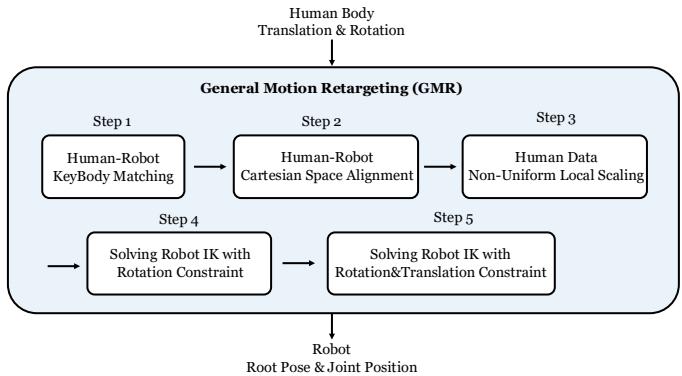
Figure: GMR's five-step retargeting pipeline [Araujo2025]
The core contribution of GMR (General Motion Retargeting) [Araujo2025] lies not in proposing a brand-new mathematical framework, but in doing optimization properly. The entire method is divided into five steps:
Step 1: Human–robot key-part mapping. The user specifies correspondences between the source human skeleton and the target robot skeleton (torso to torso, head to head, hand to hand, etc.).
Step 2: Static pose alignment. Align the orientations of the human and the robot in the zero pose (T-pose), eliminating artifacts such as "pigeon-toed" feet.
Step 3: Non-uniform local scaling (the core innovation). This is the most critical difference between GMR and other methods. Traditional methods (PHC, ProtoMotions) use global uniform scaling, i.e., scaling the entire human skeleton by the same ratio; GMR assigns an independent scaling factor to each body part
The key design here is: root translation uses uniform scaling (
Steps 4 and 5: Two-stage IK optimization. The first stage (Eq. 4) optimizes only end-effector positions and all body orientations, avoiding overly dense constraints that lead to local minima; the second stage (Eq. 6) builds on the first-stage solution and adds position constraints for all key parts for fine adjustment.
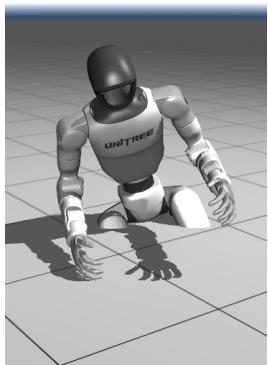
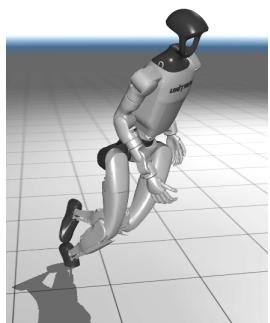
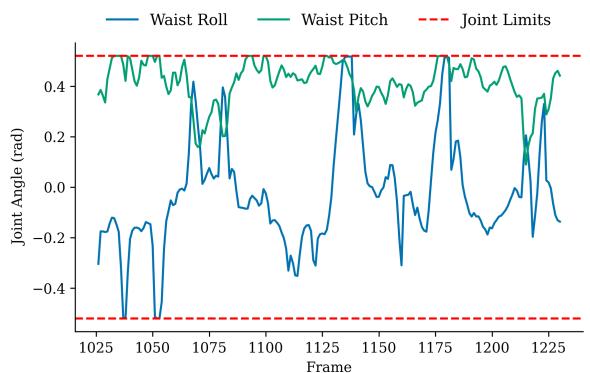
Figure: Three typical retargeting artifacts [Araujo2025]: (a) PHC's ground penetration ("Dance 1", left), (b) ProtoMotions' self-intersection ("Run (stop & go)", middle), (c) GMR's waist joint jumps ("Dance 5", right)
Experimental results. On 21 test sequences, GMR's global MPBPE median is 91.2 mm, close to the closed-source Unitree solution's 73.4 mm, and clearly better than PHC's 111.9 mm and ProtoMotions' 101.9 mm. A user study (N=20) also shows that GMR outperforms existing open-source solutions in reproducing the source motion and has approached the level of the closed-source solution.
But GMR still has limitations. It occasionally produces joint jumps (the waist problem in "Dance 5" reduces the sim-to-sim success rate to only 51%), requiring per-motion tuning of optimization weights. More fundamentally, it remains entirely in the kinematic space—ignoring physical constraints, object interaction, and the rich information in the environment. This leads to the next approach.
3. ReActor: Physics-Simulation-Assisted Bilevel Optimization Retargeting

Figure: ReActor's bilevel optimization framework [Muller2026]
ReActor [Muller2026] brings a bold shift in perspective: retargeting should be done inside the physics simulator itself. Since physics simulators inherently guarantee the correctness of contact forces, dynamics, and balance, why not use them directly during the retargeting stage, instead of waiting until after kinematic optimization and then relying on reinforcement learning to patch things up?
Bilevel optimization framework. ReActor formulates retargeting as a bilevel optimization problem:
- Upper level: optimize the retargeting parameters
- Lower level: train a reinforcement learning policy
The clever part: bypassing implicit differentiation. The computational bottleneck of bilevel optimization lies in the gradient of the lower-level optimal solution with respect to the upper-level parameters
That is, it assumes that the sensitivity of the optimal state trajectory to changes in the reference motion can be approximated by a scalar
This approximation skips the prohibitively expensive gradient backpropagation through reinforcement learning, making the entire bilevel optimization practically feasible.
Sparse correspondence. The user only needs to specify a small number of semantic rigid-body correspondences in a standard pose (T-pose)—for example, "head to head, hand to hand, foot to foot." The system automatically computes the global scaling and canonical transformation, requiring no manual parameter tuning throughout the process.
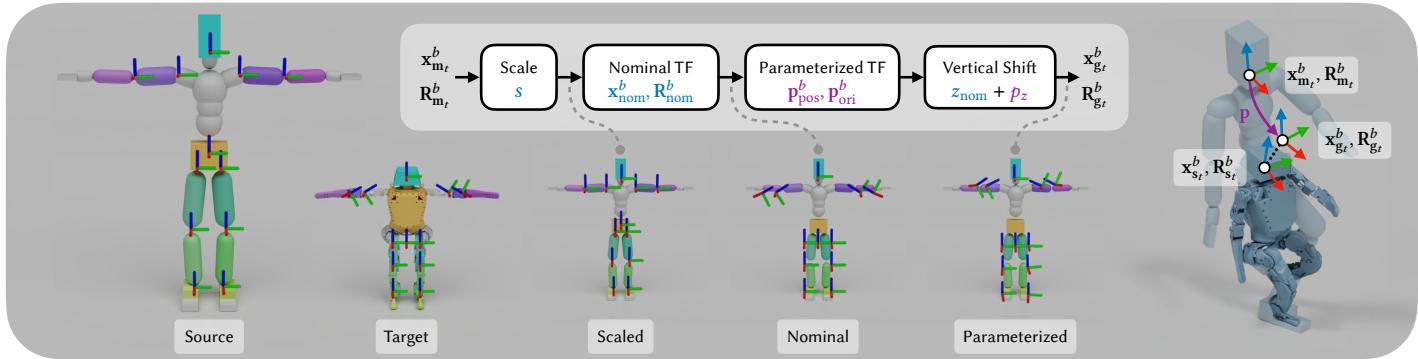
Figure: ReActor's retargeting parameterization [Muller2026]
Experimental results. Across the entire AMASS dataset, ReActor achieves zero ground penetration and zero self-intersection (both comparison methods exhibit artifacts to varying degrees). Downstream reinforcement learning success rates reach 97.45% on G1 and 95.07% on Lima, both higher than GMR (89.93%, 91.23%) and OmniRetarget (95.51%, 79.85%).
Even more notably, ReActor demonstrates cross-morphology retargeting capability: in addition to two bipedal humanoid robots (Unitree G1, Lima), it successfully transfers human motion to the quadrupedal robot ANYmal D, proving that this physics-aware approach has considerable generality.
Remaining trade-offs. The choice of the external force penalty weight represents a fundamental trade-off: the stronger the physical constraints, the more realistic the motion, but the lower the success rate on highly difficult movements; the weaker the constraints, the higher the success rate, but the worse the physical plausibility. As the authors put it:
"Ultimately, retargeting physically impossible motions remains an ill-posed problem—it is unclear whether the robot should 'walk up virtual stairs' or whether the retargeting method should project the motion onto the ground." — [Muller2026]
4. OmniRetarget: Retargeting That Preserves Interaction Relationships
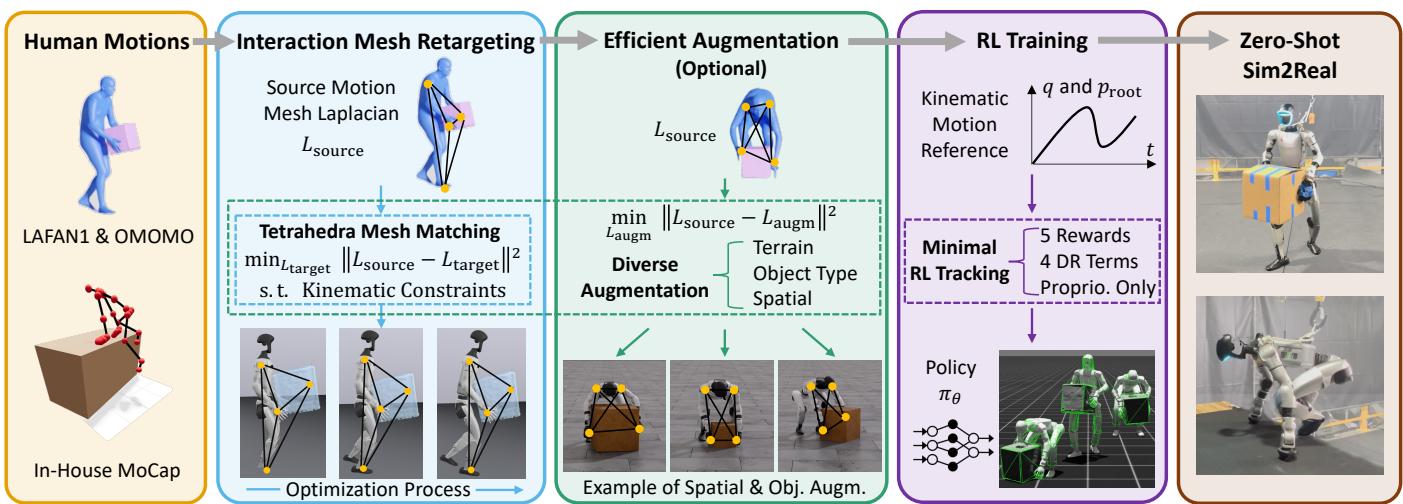
Figure: OmniRetarget's interaction-mesh retargeting framework [Yang2025]
GMR and ReActor solve the same problem—how to map body motion from humans to robots—but they both miss a key dimension: the world is not empty. Robots need to carry boxes, climb platforms, and walk on slopes. When a person lifts a heavy object, there are inseparable spatial relationships between the body posture and the object, and these relationships are entirely discarded in traditional retargeting.
OmniRetarget [Yang2025] is the first framework to systematically address this problem.
Interaction mesh. The core idea is to use Delaunay tetrahedralization to connect the robot body's joint points, object surface sampling points, and terrain surface sampling points into a three-dimensional volumetric mesh. This interaction mesh encodes the spatial and contact relationships among all elements.
Laplacian deformation energy. The retargeting problem is thereby reformulated as: under hard constraints, minimize the Laplacian deformation energy between the source (human) interaction mesh and the target (robot) interaction mesh:
where
Hard-constraint guarantees. Unlike approaches such as VideoMimic that use soft penalties, OmniRetarget enforces four types of hard constraints:
- Collision avoidance:
- Joint limits:
- Velocity limits:
- Foot sticking:
Each frame is solved with sequential second-order cone programming (SOCP), combined with trust-region constraints (
Data augmentation: one demonstration, massive data. This is another key capability of OmniRetarget. By simply changing the settings in the configuration space of the object or terrain and re-solving the optimization problem, a single human demonstration can yield hundreds of variants—different object positions, orientations, sizes, and different terrain heights. This directly alleviates the fundamental bottleneck of data scarcity for humanoid robots.
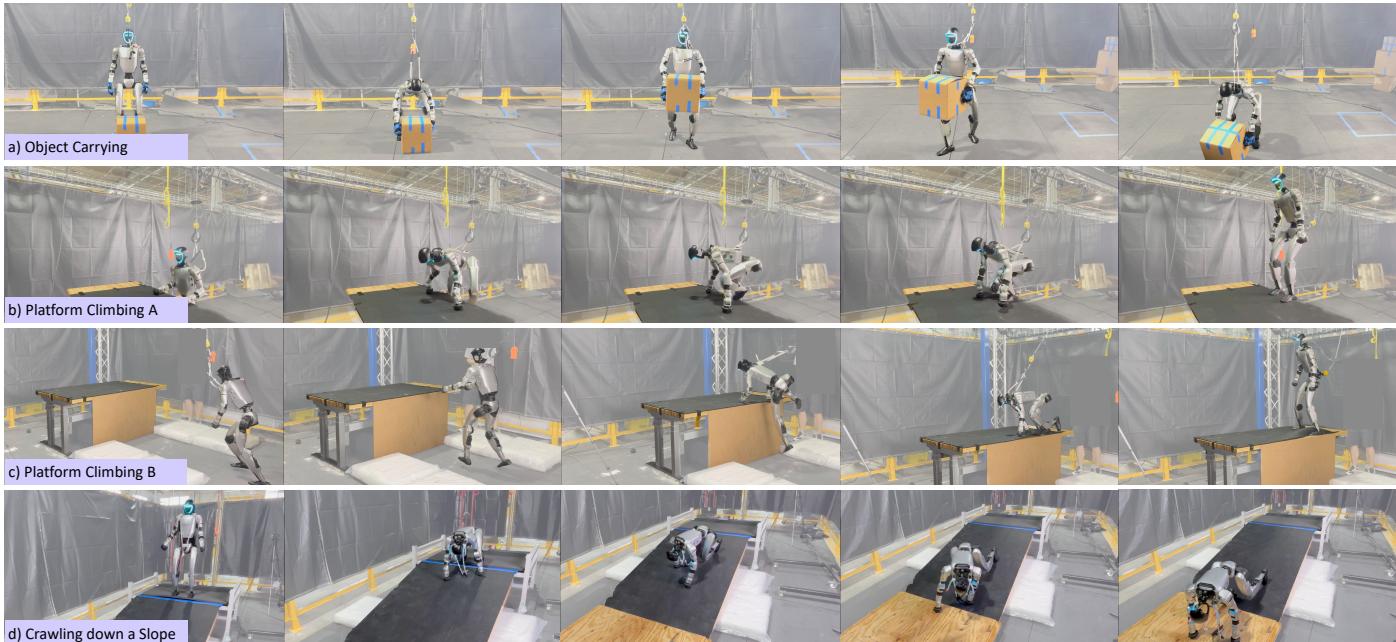
Figure: OmniRetarget hardware experiments on a real Unitree G1 [Yang2025]
Experimental results. OmniRetarget generated over 8 hours of retargeted trajectories (OMOMO 2.78h + LAFAN1 4.6h + self-collected MoCap 1h). Downstream reinforcement learning achieved an 82.20% success rate on "robot–object" tasks (PHC: 71.28%, GMR: 50.83%, VideoMimic: only 3.85%), and 94.73% on "robot–terrain" tasks (PHC: 52.63%, GMR: 78.94%).
Most impressive is its zero-shot sim-to-real transfer: on a physical Unitree G1, using only 5 reward terms and purely proprioceptive input, it completed a 30-second continuous parkour sequence (carrying a chair, climbing a platform, jumping, rolling, wall-flipping), carrying boxes, and climbing a 0.9-meter platform (equivalent to 70% of the robot's height)—a series of complex tasks.
5. NMR: Learning or Optimization?
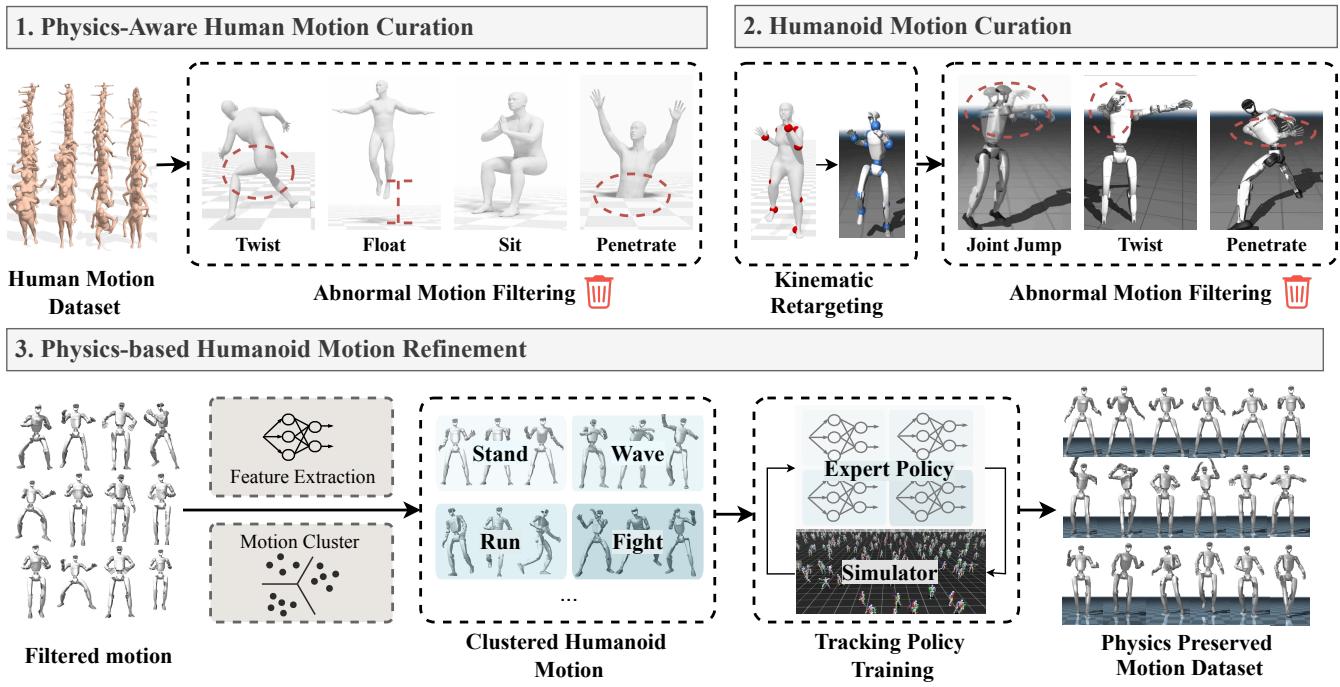
Figure: NMR's CEPR data construction pipeline [Zhao2026]
The first three papers all try hard to optimize retargeting — whether in kinematic space (GMR), inside a physics simulator (ReActor), or on an interaction mesh (OmniRetarget). NMR [Zhao2026] raises a more fundamental question: what if the problem lies in "optimization" itself?
Theoretical breakthrough: proving the non-convexity of the Hessian. NMR performs a rigorous second-order analysis of optimization objectives like GMR's. It lifts the pose error on SE(3) to the Lie algebra
The curvature correction term has two independent sources of negative curvature: (1) the curvature of forward kinematics and (2) the curvature of the logarithmic map. In particular, the coefficient
A shift in thinking: from optimization to learning. NMR's core insight is to redefine retargeting from "per-frame state optimization" to "learning a mapping between motion distributions."
The CEPR data pipeline. Since no labeled data exists off the shelf, NMR creates its own:
- Physics-aware filtering: remove abnormal motions from the raw SMPL data (excessive jerk, unstable center of mass, poor foot-ground contact);
- Kinematic retargeting plus filtering: first use GMR to obtain initial robot motions, then apply hard thresholds to discard unqualified samples (joint overspeed, self-intersection ratio >5%, average foot clearance >10 cm);
- Clustered-Expert Physics Refinement:
- Use the VAE trained by TMR to encode all motion sequences into a latent space;
- Apply K-Means for semantic clustering;
- Train a massively parallel reinforcement learning expert policy for each cluster (PPO, 16,384 parallel environments, symmetric Actor-Critic);
- After policy convergence, sample rollouts to generate approximately 30,000 physically validated (SMPL, robot) data pairs.
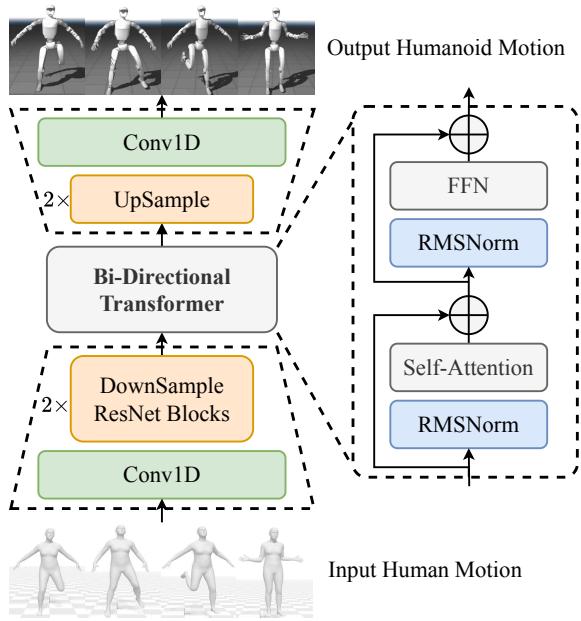
Figure: NMR's CNN-Transformer network architecture [Zhao2026]
Network architecture. NMR adopts a non-autoregressive CNN-Transformer: a 1D ResNet encoder + a full self-attention Transformer (adapted from the LLaMA architecture, but with bidirectional attention instead of causal attention so that every frame can see the full temporal context) + an upsampling decoder. Training proceeds in two stages, following a "details first, physics later" philosophy: first pre-train on large-scale kinematic data to cover a broad range of motions, then fine-tune on CEPR physically validated data to ensure physical feasibility.
Experimental results. Compared with GMR and PHUMA, NMR achieves the following:
- Zero joint jumps (GMR has 56, PHUMA has 12);
- 54% reduction in self-collisions (431 frames, versus 947 for GMR);
- 61% reduction in joint limit violations (16.80%, versus 43.21% for GMR);
- On 82 AMASS test sequences, NMR achieves the highest tracking success rate across short, medium, and long sequences alike;
- Downstream reinforcement learning policies trained with NMR references converge faster (longer episodes, higher rewards).
Even more remarkably, NMR can implicitly suppress noise from upstream SMPL estimation — the same noise would be passed through unchanged by optimization-based methods, whereas NMR filters it out during learning.
6. Where the Four Papers Sit in the Landscape of the Field
These four papers are not isolated breakthroughs; they are different facets of the same current. Below, we situate them within the broader literature.
The design space of retargeting. Current methods can be roughly positioned along two axes:
- When physics is introduced: purely kinematic (GMR, OmniRetarget) → at the data-generation stage (NMR, SPIDER) → within the retargeting process itself (ReActor, DynaRetarget);
- How decisions are made: explicit optimization (GMR, OmniRetarget, ReActor) → learned mappings (NMR, ImitationNet, AdaMorph).
The four core papers happen to occupy the four corners of this design space, forming a pattern that is complementary rather than competitive.
Signs of convergence. Several cross-references and mutual dependencies are worth noting:
- NMR uses GMR for initial kinematic retargeting in the second step of its CEPR pipeline;
- ReActor treats GMR and OmniRetarget as its primary comparison baselines;
- All four core papers target the Unitree G1 as their platform;
- OmniRetarget's author list also includes GMR's author, C. Karen Liu.
These connections indicate that the field is gradually coalescing around a shared set of problems, platforms, and evaluation criteria—although a truly unified benchmark has yet to be established.
The battle over scale. Data scale is becoming a core competitive advantage:
- GMR: 21 sequences, retargeted one by one;
- NMR: 30,000 physically validated data pairs;
- OmniRetarget: over 8 hours of retargeted trajectories;
- SPIDER [Pan2025]: 2.4 million frames, covering 9 robot morphologies.
An end-to-end perspective. Advances in retargeting are directly driving the development of the entire pipeline:
- OmniH2O [He2024] established the paradigm of "kinematic poses as a universal control interface";
- ExBody2 [Ji2025] achieved highly expressive whole-body control through teacher-student distillation;
- HOVER [He2025] distills multiple control modes into a single policy—retargeted motion is precisely its unified intermediate representation;
- ASAP [He2025]'s residual action model directly benefits from higher-quality retargeting references.
The ambition toward generality. ReActor's quadruped experiments, AdaMorph [Zhang2026]'s unified model supporting 12 morphologies, and SPIDER's coverage of 9 morphologies all point toward a grand goal: universal motion retargeting—using one model and one framework to map arbitrary human motion onto arbitrary robot bodies.
The missing pieces. Retargeting for dexterous hands (ByteDexter is an early attempt), retargeting for multi-agent interaction, and latency constraints under real-time teleoperation—these problems remain almost entirely absent from current discussions.
7. Open Questions
Synthesizing these four papers and the related literature, the following common research gaps can be identified:
1. Lack of a unified benchmark. The papers use different datasets (LAFAN1, AMASS, OMOMO), different robots (all claim G1 support, but with varying kinematic parameters), and different evaluation metrics (success rate, MPBPE, joint-jump count, penetration duration, user studies). This field urgently needs a standardized evaluation system akin to ImageNet or GLUE.
2. Cross-morphology generalization. AdaMorph [Zhang2026] makes a good start, but truly morphology-agnostic retargeting—using a single model to handle humanoid robots, quadruped robots, and even robotic arms simultaneously—is still far from realized.
3. Retargeting from noisy perception. All four core papers assume clean MoCap or SMPL input. How to perform retargeting from monocular video, depth sensors, or VR poses with significant noise and occlusion remains underexplored (OKAMI and Direct Dynamic Retargeting are early attempts).
4. Dexterous hands. The four core papers either treat the hands as rigid bodies or ignore them entirely. Retargeting for 20-DoF dexterous hands is almost an independent research direction.
5. Real-time constraints. Teleoperation requires retargeting to run at 30–120 Hz. GMR's per-frame IK is fast but only serial; NMR's neural network is parallelizable but depends on GPUs. No paper has yet systematically benchmarked inference latency.
6. Safety and failure recovery. What happens when retargeting produces infeasible or even dangerous motions? No paper currently discusses runtime safety monitoring or graceful degradation.
7. Long-horizon drift. GMR shows that artifacts accumulate continuously over a 2-minute dance sequence, eventually causing PHC to fail completely. No method yet specifically addresses error accumulation in very long sequences (5+ minutes).
8. Theoretical foundations. NMR's Hessian analysis is the first theoretical result explaining "why optimization-based retargeting fails." This field needs more theoretical work: convergence guarantees, sample complexity of learning-based methods, and a formal definition of "retargeting quality."
9. Morphological differences beyond kinematics. Humans and robots differ in mass distribution, actuator dynamics, and compliance. ReActor partially addresses this through physics simulation, but actuator-level retargeting (torque profiles, impedance) remains unexplored.
8. Retargeting: From "Supporting Role" to "Foundation"
In the brief span of two years from 2025 to 2026, motion retargeting underwent a transformation in identity—from an engineering preprocessing step to a cornerstone of motion intelligence.
GMR [Araujo2025] used rigorous experiments to demonstrate that retargeting quality is the primary bottleneck constraining downstream policy performance: done well, it yields twice the result with half the effort; done poorly, it yields half the result with twice the effort. ReActor [Muller2026] moved the entire problem into a physics simulator, making physical feasibility an outcome that "follows naturally." OmniRetarget [Yang2025] insists that the world is not empty—preserving interaction relationships with objects and terrain is precisely the key to loco-manipulation. NMR [Zhao2026] proved theoretically that traditional optimization is inherently non-convex, and in practice replaced optimization with learning.
These four approaches are not mutually exclusive, but rather complementary: NMR initializes with GMR's data, ReActor uses GMR and OmniRetarget as comparison baselines, and all methods are evaluated on the same platform. From this it is not hard to infer: future systems will likely combine learned mapping (NMR's efficient inference), physical validation (ReActor's feasibility guarantees), and interaction awareness (OmniRetarget's preservation of spatial relationships), while continuing to build on the optimization insights provided by GMR.
As humanoid robots enter the real world at an unprecedented scale—into factories, warehouses, hospitals, and homes—the quality of motion retargeting will directly determine the quality of human-robot interaction. Retargeting is no longer a preprocessing step before "throwing data at reinforcement learning," but the foundation supporting humanoid robot motion intelligence.
References
[Araujo2025] Araujo, J. P., Ze, Y., Xu, P., Wu, J., & Liu, C. K. (2025). Retargeting Matters: General Motion Retargeting for Humanoid Motion Tracking. arXiv:2510.02252.
[Muller2026] Muller, D., Serifi, A., Christen, S., Grandia, R., Knoop, E., & Bacher, M. (2026). ReActor: Reinforcement Learning for Physics-Aware Motion Retargeting. ACM Trans. Graph. (SIGGRAPH 2026). arXiv:2605.06593.
[Yang2025] Yang, L., Huang, X., Wu, Z., Kanazawa, A., Abbeel, P., Sferrazza, C., Liu, C. K., Duan, R., & Shi, G. (2025). OmniRetarget: Interaction-Preserving Data Generation for Humanoid Whole-Body Loco-Manipulation and Scene Interaction. arXiv:2509.26633.
[Zhao2026] Zhao, Q., Yang, K., Wang, X., Zhao, S., Lu, Y., Zhang, X., Yin, W., Shen, Q., Long, X.-X., & Cao, X. (2026). Make Tracking Easy: Neural Motion Retargeting for Humanoid Whole-body Control. arXiv:2603.22201.
[Luo2023] Luo, Z., Cao, J., Kitani, K., & Xu, W. (2023). Perpetual Humanoid Control for Real-time Simulated Avatars. ICCV 2023.
[He2024] He, T., Luo, Z., He, X., Xiao, W., Zhang, C., Zhang, W., Kitani, K., Liu, C., & Shi, G. (2024). OmniH2O: Universal and Dexterous Human-to-Humanoid Whole-Body Teleoperation and Learning. CoRL 2024.
[Ji2025] Ji, M., Peng, X., Liu, F., Li, J., Yang, G., Cheng, X., & Wang, X. (2025). ExBody2: Advanced Expressive Humanoid Whole-Body Control. arXiv:2412.13196.
[He2025a] He, T., Xiao, W., Lin, T., Luo, Z., Xu, Z., Jiang, Z., Kautz, J., Liu, C., Shi, G., Wang, X., Fan, L., & Zhu, Y. (2025). HOVER: Versatile Neural Whole-Body Controller for Humanoid Robots. ICRA 2025.
[He2025b] He, T. et al. (2025). ASAP: Aligning Simulation and Real-World Physics for Learning Agile Humanoid Whole-Body Skills. arXiv:2502.01143.
[Grandia2023] Grandia, R. et al. (2023). DOC: Differentiable Optimal Control for Retargeting.
[Zhang2026a] Zhang, H., Jin, S., Li, L., Li, J., Lin, L., He, X., & Zeng, Z. (2026). AdaMorph: Unified Motion Retargeting via Embodiment-Aware Adaptive Transformers. arXiv:2601.07284.
[Zhang2026b] Zhang, X., Haener, S. P., Madabushi, V., & Tucker, M. (2026). KDMR: Kinodynamic Motion Retargeting for Humanoid Locomotion via Multi-Contact Whole-Body Trajectory Optimization. arXiv:2603.09956.
[Pan2025] Pan, C. et al. (2025). SPIDER: Scalable Physics-Informed Dexterous Retargeting. arXiv:2511.09484.
[Dhedin2026] Dhedin, V. et al. (2026). DynaRetarget: Dynamically-Feasible Retargeting using Sampling-Based Trajectory Optimization. arXiv:2602.06827.
[Yan2023] Yan, Y., Mascaro, E. V., & Lee, D. (2023). ImitationNet: Unsupervised Human-to-Robot Motion Retargeting via Shared Latent Space. IEEE-RAS Humanoids 2023.
[Fu2024] Fu, Z., Zhao, Q., Wu, Q., Wetzstein, G., & Finn, C. (2024). HumanPlus: Humanoid Shadowing and Imitation from Humans. arXiv:2406.10454.
[Wang2024] Wang, J. et al. (2024). OKAMI: Teaching Humanoid Robots Manipulation Skills through Single Video Imitation. CoRL 2024.
[Figuera2024] Figuera, X., Park, S., & Ahn, H. (2024). MR.HuBo: Redefining Data Pairing for Motion Retargeting Leveraging a Human Body Prior. IROS 2024.
[Roux2026] Roux, C. et al. (2026). Direct Dynamic Retargeting for Humanoid Imitation Learning from Videos. arXiv:2605.23762.
[Lu2025] Lu, C. et al. (2025). Mobile-TeleVision: Predictive Motion Priors for Humanoid Whole-Body Control. ICRA 2025.
[Zhang2025] Zhang, H. et al. (2025). Natural Humanoid Robot Locomotion with Generative Motion Prior. arXiv:2503.09015.
[Chen2025] Chen, X. et al. (2025). Implicit Kinodynamic Motion Retargeting for Human-to-Humanoid Imitation Learning. arXiv:2509.15443.